Research
How large is the private asset impact investing market?

Summary
Explore financial returns, credit risk and benchmarking in private asset impact investing, drawing on Tameo's latest research and market analysis.
The private asset impact fund market targeting emerging and frontier economies is estimated at USD 105.2 billion in assets under management, according to Tameo's 2025 Private Asset Impact Fund (PAIF) Report, published in May 2026. The study identifies 808 active funds managed by 488 investment managers.
These figures describe a specific segment of the wider impact investing industry: private asset investment strategies that combine financial objectives with intentional development and impact outcomes in emerging and frontier markets.
Understanding this distinction matters. Estimates of the overall impact investing market encompass a much broader range of asset classes, geographies and investment approaches. Tameo's PAIF research examines a more narrowly defined universe, providing a basis for analysing how capital is allocated, managed and deployed.
A USD 105 billion market
Tameo's sixth annual PAIF Report identifies:
Market indicator | 2025 report |
|---|---|
Estimated assets under management | USD 105.2 billion |
Active impact funds | 808 |
Investment managers | 488 |
Equity strategies' share of total AUM | 54% |
Assets in blended finance funds | USD 26.7 billion |
The report draws on Tameo's proprietary market database and includes detailed primary research from 210 funds and 104 investment managers.
The distinction between the wider market universe and the survey sample is important. Market-level estimates describe the identified investment universe, while more detailed performance, portfolio and impact indicators rely on data contributed by participating managers.
How is the market structured?
Private asset impact funds invest through a variety of strategies, including private debt, private equity and venture capital. Their mandates differ by geography, sector, financing instrument, target population and intended development outcome.
Equity strategies, including private equity and venture capital, represent 54% of total market assets under management in the 2025 PAIF Report.
Climate and energy strategies, alongside funds addressing multiple Sustainable Development Goals, account for major thematic allocations. Investment approaches range from financing smaller enterprises and financial institutions to supporting renewable energy, infrastructure and other sectors associated with sustainable development.
The breadth of these strategies makes the private asset impact fund market difficult to assess through a single benchmark. Fund structures, liquidity characteristics, risk exposures and impact objectives can differ considerably.
Where is impact capital being invested?
Emerging and frontier economies are the geographical focus of the PAIF universe, but the location of investment management and the destination of capital are not necessarily the same.
Tameo's research finds that much of the capital targeting these markets is managed from developed economies. Sub-Saharan Africa remains the largest regional focus among funds pursuing a single-region strategy.
This distinction between fund domicile, manager location and investment destination is relevant when assessing the geographical distribution of impact capital. It also influences how investors interpret market concentration, local financing capacity and exposure to individual regions.
The role of blended finance
Blended finance remains a significant feature of the market.
Approximately one-quarter of the funds identified in the 2025 PAIF Report employ blended finance structures, representing USD 26.7 billion in assets under management.
These structures combine capital with different financial or developmental objectives, potentially allowing investors to finance opportunities that might otherwise fall outside conventional risk-return requirements.
Their design nevertheless requires careful assessment. The presence of concessional capital alone does not establish additionality or development impact. Investors must consider how risks and returns are distributed, what activities the structure enables, and whether its intended objectives are achieved.
A more challenging fundraising environment
After a period of substantial expansion, the pace of new fund creation has slowed.
Tameo records 64 new PAIF launches in 2024 and a provisional count of 14 in 2025, subject to revision as additional funds are identified.
The slowdown takes place against a backdrop of tighter fundraising conditions, changing development finance priorities and greater scrutiny of investment performance and demonstrable outcomes.
While the market continues to attract capital across a wide range of investment strategies, the recent decline in launches illustrates the importance of distinguishing an established stock of managed assets from the pace of new market activity.
Why market transparency matters
For institutional investors, development finance institutions and fund managers, understanding the size of the market is only the starting point.
Investment decisions require more granular information: comparable fund strategies, manager track records, financial performance, portfolio risk, impact indicators and the consistency of reporting practices.
This is the purpose of Tameo's ongoing market research. By combining a structured investment universe with annual surveys and fund-level analysis, the PAIF research aims to improve transparency in a market where information is often fragmented or privately held.
Source: Tameo Impact Fund Solutions, 2025 Private Asset Impact Fund Report: Navigating the global development aid reduction, published May 2026.
Related resource
Contact

Ramkumar Narayanan
Head of Products & Services
Recent media

Tameo joins PROMOLAC2030 to map Latin America's impact fund landscape
Company,
Tameo is partnering with AlphaMundi Group, Latimpacto, and GSG Impact to map Latin America's impact fund landscape for a year-end report. Impact fund managers in the region can get involved by us.
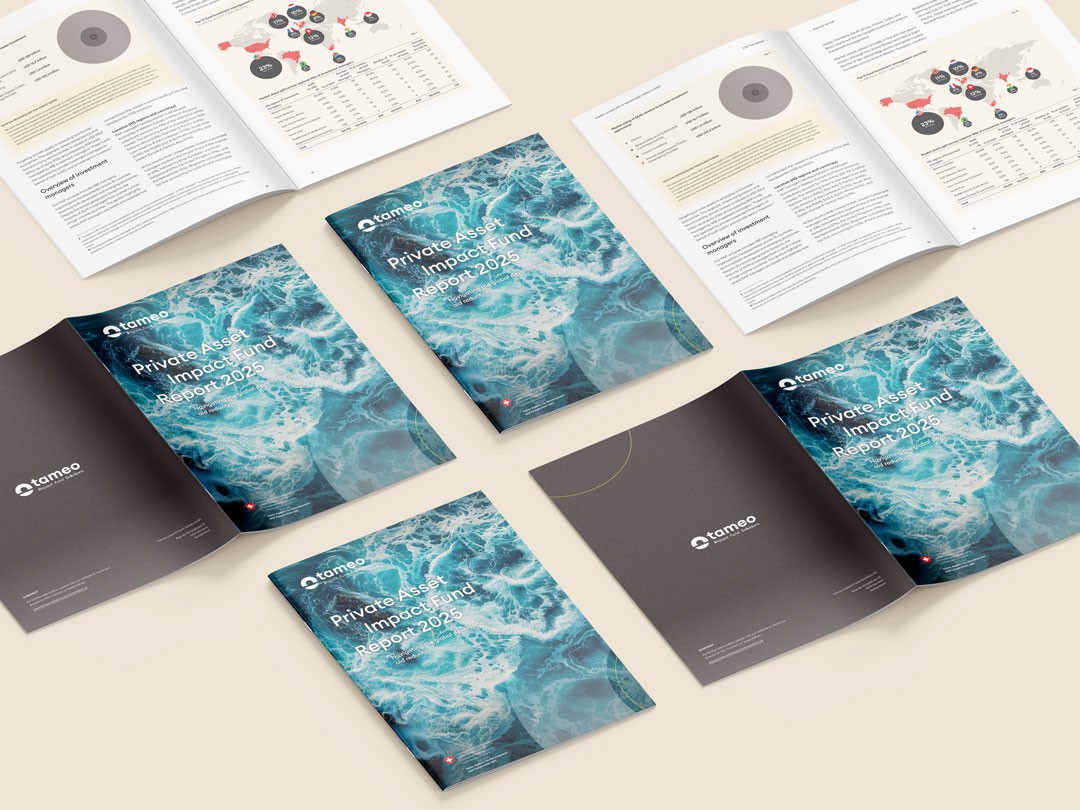
Tameo releases 2025 Private Asset Impact Fund Report covering a USD 105 billion impact investing market
Market Study,
Tameo's latest PAIF Report, now in its sixth edition, analyses USD 105.2 billion in private asset impact funds across emerging and frontier markets, covering 808 funds and 488 managers.

Tameo to present new insights on African private markets at Building Bridges webinar
Company,
Tameo will take part in a Building Bridges Foundation webinar titled “From Data to Deployment: Mobilizing Capital for Impact in Sub-Saharan Africa” on 24 March 2026, 14:00–15:00 CET.