Impact Verification
How is impact measured and verified in private markets?

Summary
How do investors measure and verify impact? Explore data collection, reporting practices and independent verification frameworks that strengthen accountability.
Impact measurement in private markets involves collecting, validating and interpreting information about the social and environmental effects of investments. Independent impact verification serves a related but distinct purpose: assessing whether an investor's impact management practices align with recognised frameworks and whether those practices are consistently implemented.
Both are important to the credibility of impact investing. Measuring outcomes helps investors understand what their capital is supporting. Verification provides an independent assessment of the systems used to manage impact throughout the investment lifecycle.
Neither exercise should be confused with a guarantee that every reported outcome was caused by an investment.
What does impact measurement involve?
Impact measurement starts with a clear understanding of what an investment is intended to achieve.
An investor financing financial inclusion, for example, may want to understand how many underserved individuals or businesses gain access to financial services, whether that access improves over time, and whether the financing contributes to meaningful changes in economic opportunity.
The measurement process normally involves several interconnected activities.
Defining objectives. Establishing the social or environmental outcomes an investment strategy seeks to contribute to.
Selecting indicators. Identifying measurable information relevant to those objectives, with clear definitions and appropriate reporting periods.
Collecting information. Obtaining data from portfolio companies, financial intermediaries or other relevant sources.
Validating data. Reviewing reported information for completeness, consistency and plausibility.
Analysing results. Interpreting performance against objectives, prior periods and relevant benchmarks.
Reporting findings. Communicating results alongside limitations, assumptions and relevant risks.
The quality of measurement depends on the consistency of these steps, not simply on the volume of indicators collected.
From activities to outcomes
One of the central challenges in impact measurement is distinguishing between activities, outputs and outcomes.
Consider an investment in a financial institution serving small businesses.
The amount of financing disbursed is an activity or financial output. The number of businesses reached provides information about the scale of that activity. Changes in business resilience, employment or access to opportunity may represent outcomes.
These measures answer different questions.
The fact that capital was deployed does not automatically demonstrate that the intended development outcomes occurred. Similarly, a positive change observed among beneficiaries does not necessarily establish that the investment was solely responsible.
Credible impact reporting therefore benefits from a clear theory of change, careful indicator selection and transparent treatment of the limits of attribution.
The challenge of collecting reliable portfolio data
Private asset impact investors frequently obtain information from multiple funds, investees and reporting systems.
Each organisation may use different templates, reporting periods or indicator definitions. Data may also arrive through spreadsheets, emails and disconnected databases, creating difficulties for validation and aggregation.
This fragmentation matters when investment managers and asset owners need to compare results across portfolios.
Standardised indicators and reporting processes can improve consistency, while documented review procedures help identify missing information and unexpected changes.
Digital systems can support these processes by organising reporting campaigns, automating checks and preserving a record of data submissions and revisions.
Tameo's Baseline platform is designed for systematic ESG and impact data collection, aggregation and validation across portfolio companies, fund managers and institutional investors.
Its purpose is to provide a structured information base for subsequent reporting and analysis.
What is independent impact verification?
Independent impact verification examines the practices through which an investor defines, manages, monitors and communicates impact.
A recognised reference point is the Operating Principles for Impact Management, commonly known as the Impact Principles.
The nine principles provide a framework for integrating impact considerations throughout the investment lifecycle, from defining strategic objectives to managing investments, reviewing performance and disclosing alignment.
Signatories commit to publishing information about their alignment with the principles and arranging independent verification of that alignment.
Importantly, this type of verification assesses an organisation's impact management system and practices. It should not be interpreted as certification that every investment has delivered its intended outcomes.
How does the verification process work?
Tameo's approach to Impact Principles verification combines documentary assessment, expert review and benchmarking against disclosed industry practices.
The process comprises three main stages.
1. Data gathering
The verification team reviews relevant policies, investment guidelines, impact and ESG frameworks, and portfolio information.
The assessment can also include samples of investment memoranda and impact data, together with interviews to understand internal responsibilities and decision-making processes.
2. Assessment
The organisation's practices are assessed against the nine Impact Principles.
This includes examining how impact objectives are established, integrated into investment decisions, monitored and reviewed.
Tameo complements expert assessment with analytical tools that compare documented practices against those disclosed by other Impact Principles Signatories.
3. Recommendations and verification
The process results in a public verification statement and a more detailed assessment report, including observations and recommendations for strengthening impact management.
Benchmarking provides additional context by comparing practices with relevant peers.
The purpose is not simply to establish whether procedures exist, but to assess their implementation and identify opportunities for improvement.
Why independent verification matters
As impact investing becomes more established, investors face increasing expectations concerning the credibility of their impact claims.
Fund managers must demonstrate how impact objectives influence investment decisions. Asset owners need confidence in the information provided by their managers. Development finance institutions and other stakeholders require evidence that impact management practices are systematic and appropriately governed.
Independent verification provides an external perspective on these processes.
However, verification does not replace ongoing measurement, monitoring or evaluation. A robust impact management system should be supported by reliable portfolio data and an organisational willingness to respond when results differ from expectations.
Towards more decision-useful impact reporting
The value of impact reporting ultimately depends on whether the information helps investors make better decisions.
Reports should make objectives, results, methodologies and limitations understandable. They should also connect reported performance to the decisions and responsibilities of investment managers.
This requires coordination between investment teams, impact specialists, data systems and governance functions.
Tameo supports this work through impact data collection, investor-grade reporting and independent verification of impact management practices.
Taken together, these activities provide a more coherent approach to measuring, managing and demonstrating impact in private markets.
Related resource
Contact

Recent media

Tameo joins PROMOLAC2030 to map Latin America's impact fund landscape
Company,
Tameo is partnering with AlphaMundi Group, Latimpacto, and GSG Impact to map Latin America's impact fund landscape for a year-end report. Impact fund managers in the region can get involved by us.
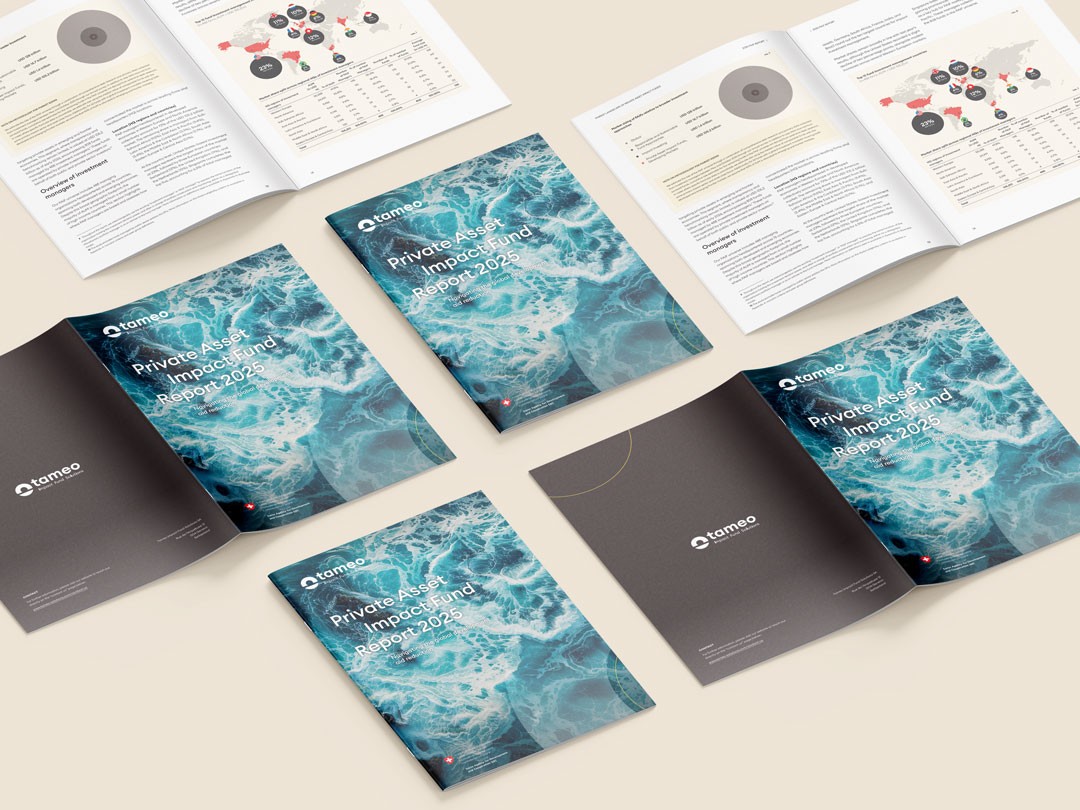
Tameo releases 2025 Private Asset Impact Fund Report covering a USD 105 billion impact investing market
Market Study,
Tameo's latest PAIF Report, now in its sixth edition, analyses USD 105.2 billion in private asset impact funds across emerging and frontier markets, covering 808 funds and 488 managers.

How do private asset impact funds perform?
Private Asset Impact Funds,
Explore financial returns, credit risk and benchmarking in private asset impact investing, drawing on Tameo's latest research and market analysis.